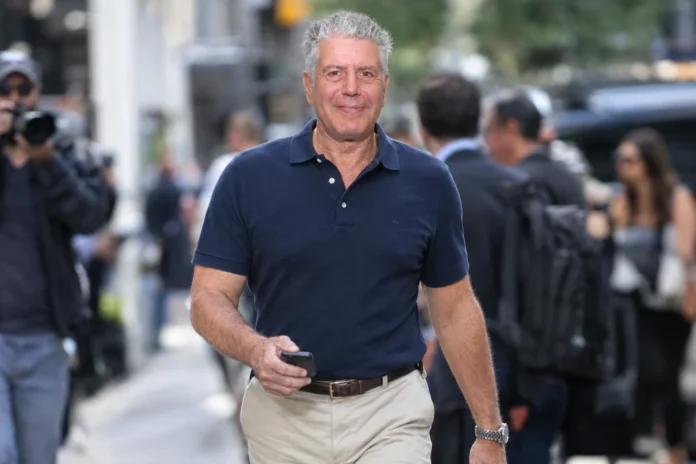
Anthony Bourdain was the chef who turned a kitchen memoir into a worldwide conversation about food, travel and human curiosity. Anthony Bourdain died on June 8, 2018, at age 61, while filming Parts Unknown in France. This guide covers his life, shows, movies, quotes, family and the facts about his death.
Biography Table
| Field | Details |
|---|---|
| Full Name | Anthony Michael Bourdain |
| Nickname | Tony |
| Date of Birth | June 25, 1956 |
| Place of Birth | New York City, U.S. |
| Date of Death | June 8, 2018 (Kaysersberg, Alsace, France) |
| Age | 61 (at death) |
| Nationality | American |
| Zodiac Sign | Cancer |
| Ethnicity | French and Jewish American heritage |
| Profession | Chef, author, television host, producer |
| Years Active | 1978–2018 |
| Education | Culinary Institute of America (graduated 1978); attended Vassar College |
| Genre/Field | Food, travel, television, nonfiction and crime fiction |
| Spouse/Partner | Nancy Putkoski (m. 1985, div. 2005); Ottavia Busia (m. 2007, separated 2016) |
| Relationship Status | Deceased; in a relationship with Asia Argento at the time of his death |
| Children | One daughter, Ariane Busia-Bourdain |
| Parents | Pierre Bourdain and Gladys Bourdain |
| Siblings | Christopher Bourdain (younger brother) |
| Net Worth | About $1.2 million per probate filings; some estimates run far higher |
| Height | 6’4″ (193 cm) |
| Notable Works | Kitchen Confidential, A Cook’s Tour, No Reservations, Parts Unknown |
| Awards/Honors | Peabody Award (2013), multiple Emmy Awards |
Who Was Anthony Bourdain? Early Life and Rise
Bourdain grew up in Leonia, New Jersey, and later described a childhood oyster eaten on a family trip to France as the moment food captured him. His first job was washing dishes in Provincetown, Massachusetts, which he often called the start of his real education. He briefly attended Vassar College, then graduated from the Culinary Institute of America in 1978.
His early kitchen years were rough and unglamorous. He worked long shifts, cooked brunch he came to dislike, and moved through restaurants before becoming executive chef at Brasserie Les Halles in New York. He also dreamed of drawing comics, an ambition that resurfaced decades later in his graphic novels.
The turning point came late. Bourdain was 44 when Kitchen Confidential was published, and he often said he never expected real success before his forties. That timing shaped his voice. He wrote like someone who had already lived through the bad years and had nothing left to fake.
Anthony Bourdain’s Career: From Chef to Global TV Host
Bourdain’s television career grew out of his writing. A publisher’s interest in his book led to a food-and-travel series, and each new show pushed him further from restaurant kitchens and closer to storytelling. The pattern is easy to see when you list his shows in order.
| Show | Network | Years | What It Did |
|---|---|---|---|
| A Cook’s Tour | Food Network | 2002–2003 | Chasing a “perfect meal” around the world |
| No Reservations | Travel Channel | 2005–2012 | Culture, food and candid travel |
| The Layover | Travel Channel | 2011–2013 | Short city guides for travelers |
| Parts Unknown | CNN | 2013–2018 | Politics, history and people through food |
He also narrated and executive produced The Mind of a Chef and served as a judge on The Taste. Working across networks let him experiment, and each show was less about him and more about the people on screen.
One thing stands out when you revisit his episodes. The food is almost always the excuse. The real subject is who sits at the table and why they are there.
Anthony Bourdain: No Reservations Explained
No Reservations is the series most fans point to as Bourdain at his loosest. It ran on the Travel Channel from 2005 to 2012 and followed him to street stalls, family kitchens and places tourists usually skipped. It earned him Emmy recognition and set the visual and editorial style that Parts Unknown later refined.
The show could also be dangerous. During a 2006 trip to Lebanon, war broke out and the crew had to be evacuated. Bourdain later turned the experience into a thoughtful episode about how quickly a place he was enjoying could be torn apart.
Compared with Parts Unknown, this earlier show is more playful and food-first. If you want the swagger and the jokes, start with No Reservations. If you want the heavier, more cinematic Bourdain, move to CNN.
Anthony Bourdain Movies and Documentaries
Bourdain never became a Hollywood actor, but films still orbit his story. The best-known is Roadrunner: A Film About Anthony Bourdain (2021), directed by Morgan Neville. It drew strong reviews and some controversy over how the filmmakers recreated a few lines in his voice.
He also served as an executive producer on Wasted! The Story of Food Waste (2017), a documentary about how much edible food is thrown away. It reflects an issue he cared about in kitchens, and it fits his broader habit of pointing a camera at things people would rather ignore.
His book also inspired Kitchen Confidential, a short-lived 2005 sitcom on Fox. It was a loose adaptation, so fans hoping for the real story should read the book instead.
Kitchen Confidential and Bourdain’s Books
Kitchen Confidential began as an article, “Don’t Eat Before Reading This,” in The New Yorker in 1999. Publishers reached out within days, and the book that followed in 2000 became a bestseller. It described 12-hour kitchen days, cooks who cut corners and a culture of excess, in a voice influenced by writers like George Orwell.
Bourdain wrote more than memoirs. His crime novels came first, and later he moved into graphic novels and cookbooks.
| Title | Year | Type |
|---|---|---|
| Bone in the Throat | 1995 | Crime novel |
| Gone Bamboo | 1997 | Crime novel |
| Kitchen Confidential | 2000 | Memoir |
| The Bobby Gold Stories | 2001 | Fiction |
| Medium Raw | 2010 | Essays |
| Get Jiro! | 2012 | Graphic novel |
| Hungry Ghosts | 2014 | Graphic anthology |
His prose is short, blunt and funny. That is the easiest part of his style to imitate and the hardest to match.
Anthony Bourdain’s Personality and Public Persona
At 6’4″ with a deep, gravelly voice, Bourdain looked the part of a tough chef. People who worked with him described someone quieter and shyer than the screen persona, an attentive listener who asked good questions and let guests talk. Producers and crew often said the on-screen Tony and the off-screen Tony were closely matched, because he simply didn’t do fake.
The media loved to call him the “Elvis of bad boy chefs.” He was irreverent and honest, but also curious and kind to the people who fed him. He was loyal to his crew and fixers, the local guides who helped shoot each episode.
Fame did not sit easily with him. He grew uneasy about being a brand, and he often seemed more comfortable behind the scenes than in front of crowds.
Music and Cultural Influences on Bourdain’s Work
Bourdain’s taste in music and film shaped how his shows looked and sounded. He loved punk and rock, and he brought in artists like Iggy Pop, whose music and conversation appeared across his career. Original music and sharp editing were part of the production formula that made his episodes feel unlike other travel TV.
Film mattered just as much. He often said he was steeped in directors like Wong Kar-Wai and Bernardo Bertolucci, and he worked with cinematographer Christopher Doyle on the Hong Kong episode. That episode was directed by Asia Argento.
The result was travel television built like cinema. Bands like the Brian Jonestown Massacre and System of a Down appear on his lists of favorites, but the larger point is that he treated music and images as storytelling tools, not decoration.
Addiction, Depression and Struggles in Anthony Bourdain’s Life
Bourdain wrote openly about his addiction years. In the 1980s he struggled with heroin and cocaine, and he spoke about the debt, chaos and lack of health insurance that came with that period. He often credited his eventual success with pulling him out of that lifestyle.
Later, he spoke about therapy and the difficulty of managing his moods. He was discreet about depression, which he treated as something to work through privately rather than turn into content. Fans often saw only the confident surface, which is why his death felt so sudden.
Addiction and depression are separate conditions, and the same person can carry both. Understanding that makes the story of his final years easier to read without reducing it to a simple cause.
Anthony Bourdain and Asia Argento: The Relationship Explained
Bourdain and Asia Argento became a couple in early 2017 and were quickly seen together in public. Friends said he seemed happier and lovestruck. Argento, an Italian actress and director, had spoken out about Harvey Weinstein, and Bourdain publicly supported her. The Hong Kong episode of Parts Unknown, which she directed, was one of their shared projects.
Their relationship was later described as open. In the days before his death, photos of Argento with another man circulated widely, and the internet turned quickly to blame. Some commentators, including addiction expert Stanton Peele, offered a “love addiction” theory. It remains a theory, not an established fact.
The honest position is that nobody outside a relationship can know what happened inside it. Blaming a partner for someone’s suicide is unfair and misleading.
How Did Anthony Bourdain Die?
Anthony Bourdain died by suicide on June 8, 2018, at Le Chambard hotel in Kaysersberg, in the Alsace region of France. He was in the country filming an episode of Parts Unknown with his close friend, chef Éric Ripert, who found him on Friday morning.
| When | What Happened |
|---|---|
| Night before | Dinner with Ripert and the crew |
| Friday morning | Ripert found him in his hotel room |
| Same day | French authorities confirmed suicide as the cause |
| Following days | Toxicology results came back negative for drugs |
CNN announced the news that day. Then-president Jeff Zucker sent a staff email calling him a friend and colleague. The announcement stunned viewers, since a new season of Parts Unknown had premiered only weeks earlier.
Ripert spoke publicly about the shock and grief of that day. He described a man who had seemed preoccupied but functional, and said he had not seen it coming. That detail matters, because it shows how hidden the pain can be even to close friends.
Why Did Anthony Bourdain Kill Himself? What We Know
This is the most searched question about his death, and the honest answer is that no one can say for certain. Suicide almost never has a single cause. Experts consistently warn against pointing to one event, one person or one bad week.
What is known is limited. Bourdain had spoken about dark periods and therapy, and he had been under professional and personal pressure in his final months. Toxicology testing showed no drugs in his system, which ruled out a relapse as an explanation.
The public tried to fill the gaps with theories about his relationship, his fame or his past. Most of it was speculation. A more respectful way to remember him is to focus on the life and work he left behind, and on the fact that the people around him were as shocked as anyone.
Anthony Bourdain’s Daughter and Family Life
Bourdain’s only child is his daughter, Ariane Busia-Bourdain, born in 2007. She was 11 when he died. Her mother is Ottavia Busia, a former mixed martial arts fighter whom Bourdain married in 2007. The couple separated in 2016, and Bourdain was estranged from her in his final years.
Bourdain shared his wife’s interest in martial arts. He was a fan of MMA and trained in Brazilian jiu-jitsu himself, which gave him a hobby that was physical, disciplined and far from a kitchen.
His first marriage, to Nancy Putkoski, began in 1985 and ended in divorce in 2005. He was close to his younger brother Christopher, and his parents, Pierre and Gladys, were a steady presence in the stories he told about growing up.
Anthony Bourdain’s Net Worth and Will
The most commonly cited figure for Bourdain’s estate is around $1.2 million, based on probate filings after his death. Other estimates during his lifetime placed his wealth far higher, at up to $16 million. The gap partly comes from how assets were held, since a portion reportedly sat in a trust rather than passing through the will.
His will left his assets to his daughter, Ariane. That fits how he talked about his priorities in interviews, and it means the numbers you see online are estimates, not audited totals.
His income came from books, television, appearances and production work. His reputation, rather than his bank balance, is what made his career valuable.
Anthony Bourdain’s Legacy and the Bourdain Effect
Bourdain changed how audiences think about travel. His shows gave voice to marginalized communities and to restaurant staff who were rarely on camera. He advocated for safer working conditions for cooks and dishwashers, and he stood up for immigrants in kitchens across America.
The “Bourdain Effect” describes what happened when he featured a restaurant. Tourists flooded in, and small family places were sometimes overrun. He knew this and openly wrestled with whether he was part of the problem, especially on trips to places like Haiti.
His most lasting influence may be the tone he set. Curious, humble and unwilling to talk down to anyone, that approach reshaped food media. Many current travel and food creators follow his lead, often without realizing it.
Anthony Bourdain Quotes Worth Remembering
His quotes stick because they are short and direct. A few widely shared lines show his range:
- “Skills can be taught. Character you either have or you don’t have.” (on hiring cooks)
- “Your body is not a temple, it’s an amusement park. Enjoy the ride.”
- “Travel isn’t always pretty. It isn’t always comfortable.” (on the reality of travel)
Each one reflects a different side of him. The first is his kitchen-boss realism, the second is his appetite for life, and the third is his refusal to romanticize travel.
Travel Philosophy and Tips from Anthony Bourdain
Bourdain’s approach can be turned into practical habits:
- Eat where locals eat, especially at busy markets and small counters.
- Wake up early to see local markets at their best.
- Stay curious about places you think you already know.
- Say yes to invitations and act like a guest.
He returned often to Japan, which he described as a life-changing first trip, and he loved the food halls of Barcelona, including La Boqueria. Uruguay’s grill culture also appears in his travels.
The lesson is simple. Curiosity beats a checklist, and a meal is a good way to start a conversation.
FAQs
What Was Anthony Bourdain’s Favorite Food?
He loved simple, well-made food more than fancy dining. Vietnamese street food, especially noodles, was a favorite, and he famously shared a cheap meal with Barack Obama in Hanoi. He also praised In-N-Out and disliked trends and brunch culture.
Which Anthony Bourdain Show Should I Watch First?
Start with No Reservations if you want humor and food-driven travel. Choose Parts Unknown if you want the more cinematic and reflective version. Both are strong entry points for anyone exploring Anthony Bourdain’s shows.
Which Anthony Bourdain Book Should I Read First?
Kitchen Confidential is the best starting point. It is his breakout memoir and explains the voice behind everything else. If you prefer fiction, try The Bobby Gold Stories.
Did Anthony Bourdain Feud with Other Chefs?
Yes, he criticized celebrity chefs such as Guy Fieri, Paula Deen and Emeril Lagasse early in his career. Over time he softened his tone and sometimes admitted he had been too harsh. It shows a man willing to reconsider his own opinions.
Did Anthony Bourdain Train in Martial Arts?
Yes, he trained in Brazilian jiu-jitsu at the Renzo Gracie Academy in New York. He treated it as a serious discipline, and it became a big part of his life in his final years.
Read About : arch manning
